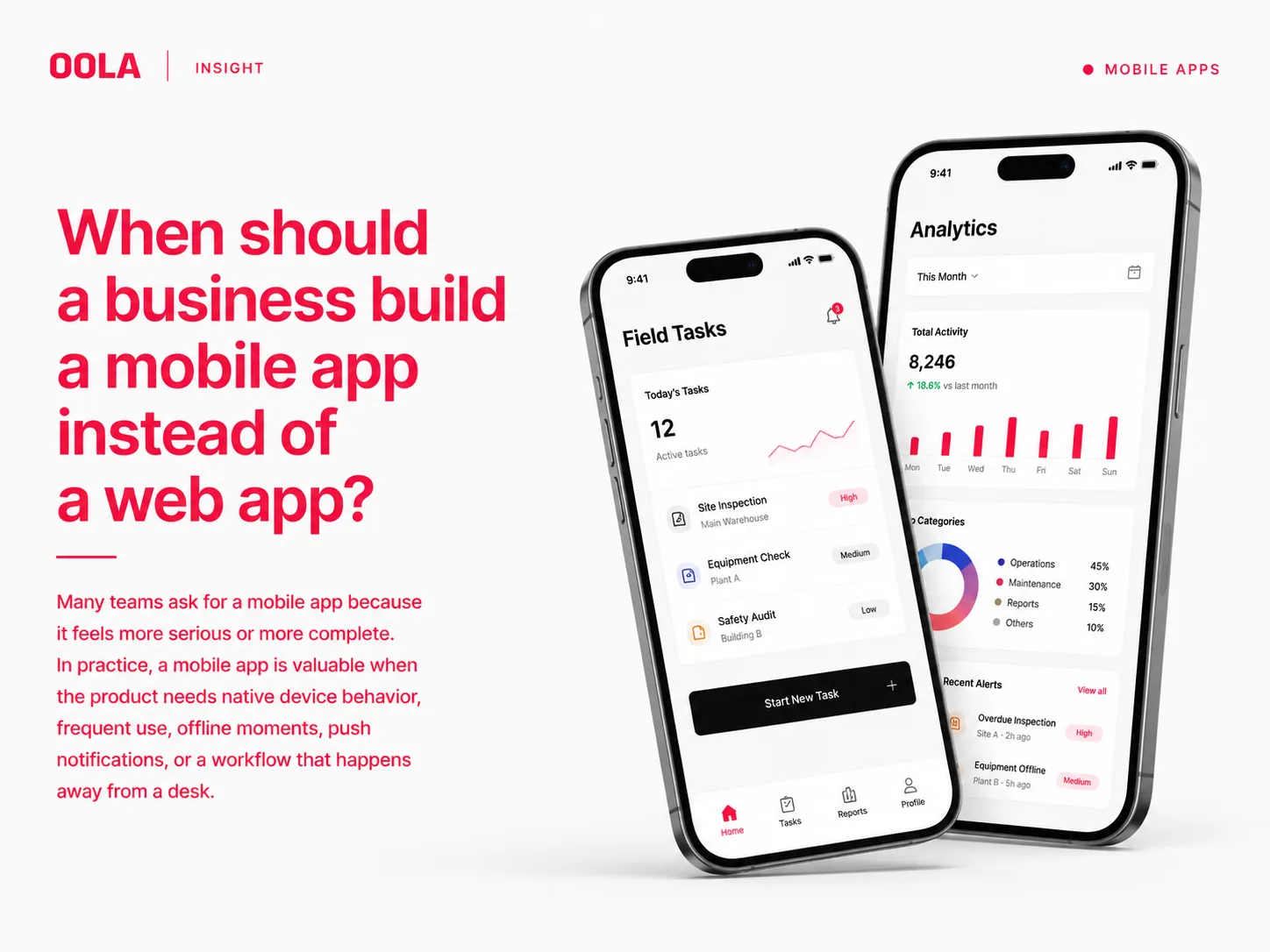
Many teams ask for a mobile app because it feels more serious or more complete. In practice, a mobile app is valuable when the product needs native device behavior, frequent use, offline moments, push notifications, or a workflow that happens away from a desk.
Frequency matters.
If users only need the product occasionally, a web app may be easier to access and maintain. If users need the product every day, especially in short repeated sessions, a mobile app can reduce friction.
The question is not whether mobile looks more polished. The question is whether users will benefit from having the product installed, remembered, and ready in the context where the work happens.
Device context can justify native investment.
Mobile apps become stronger when the product depends on camera access, location, biometrics, push notifications, offline storage, background behavior, or device-specific workflows.
For field teams, education products, loyalty systems, and operational utilities, those capabilities can be central. For content-heavy marketing or admin-heavy workflows, a responsive web app may be more practical.
Maintenance is part of the decision.
Mobile apps require app store releases, platform updates, device testing, and long-term version management. This is manageable when the app has a clear role, but it becomes wasteful when the product could work well on the web.
A useful early decision is to define what must be native and what can stay web-based. Some businesses need both: a mobile utility for field use and a web dashboard for admin work.
Start from the user's environment.
If the user is standing, moving, scanning, capturing, checking in, or receiving time-sensitive prompts, mobile may be the right primary surface. If the user is comparing, configuring, analyzing, writing, or managing many records, web may be the stronger starting point.
A good product plan can phase these surfaces. The first release does not need to solve every platform at once.
Key Takeaways
Build mobile when the context and behavior make installation valuable.
Native features should justify native complexity.
Some systems work best as a web admin plus a focused mobile utility.