Interactive systems are useful when a business needs more than passive content. They can support learning, onboarding, brand engagement, product education, customer participation, and internal training through structured actions and feedback.
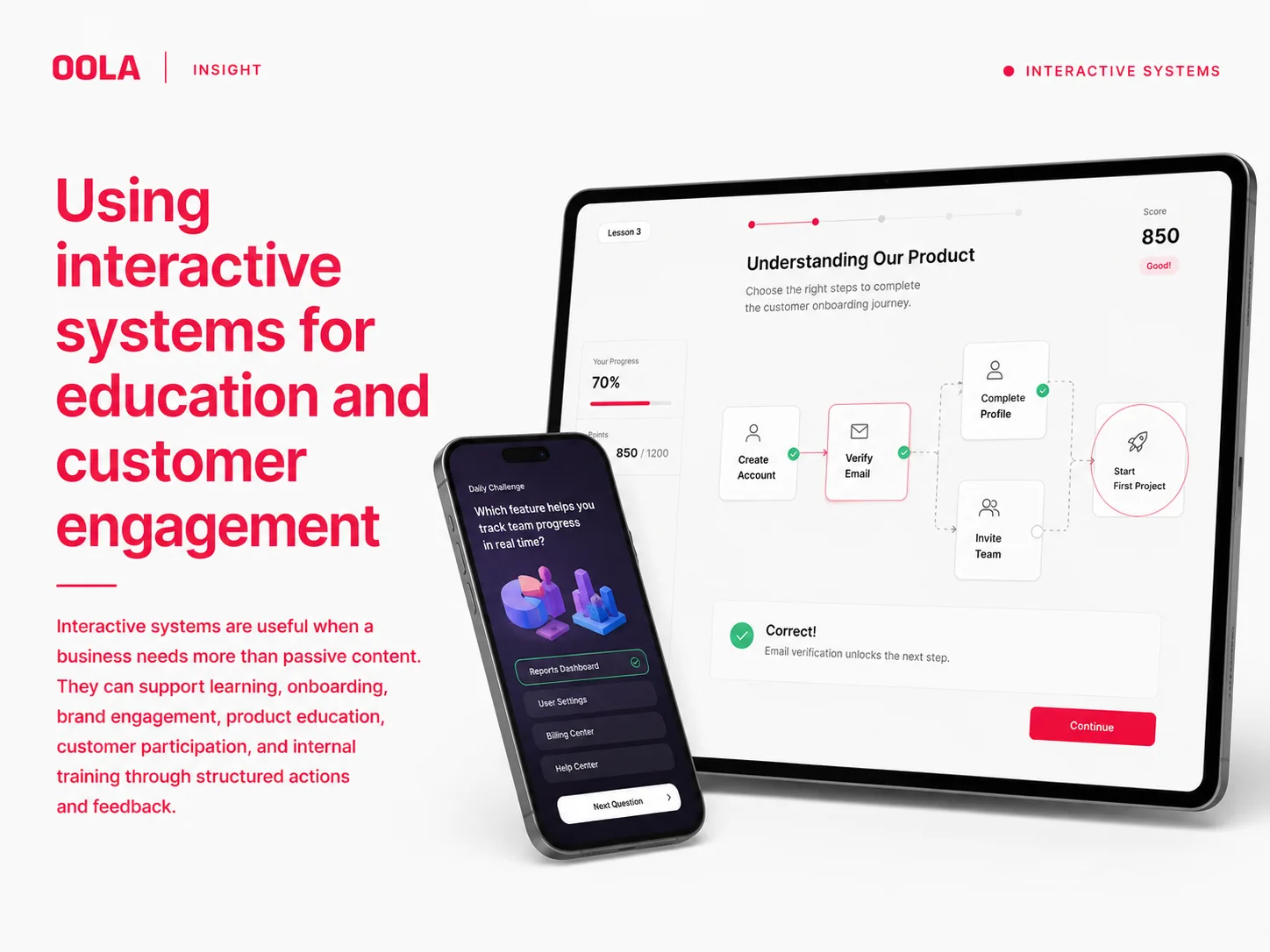
Interaction is a system of rules.
A strong interactive experience is not only animation or game-like visuals. It is a set of rules that tells users what they can do, what happens next, and how progress is recognized.
This is why the early design process should define actions, feedback, progression, scoring or completion logic, and the role of content. The visual layer becomes clearer when the interaction model is already understood.
Education needs feedback loops.
For learning products, interaction can make progress easier to understand. Users can receive feedback after choices, unlock the next step, repeat a module, or see how their actions affect an outcome.
This does not require heavy gamification. Sometimes the most effective system is simple: clear tasks, immediate response, visible progress, and a final state that confirms completion.
Engagement should support a business goal.
Interactive campaigns and branded experiences can attract attention, but attention alone is not enough. The system should connect to a measurable goal such as education, lead capture, product understanding, onboarding, retention, or customer insight.
When the goal is clear, the experience can stay focused. The team can decide which data matters, what the user should remember, and which interaction moments are worth building.
Make the system maintainable.
Interactive systems can become difficult to maintain if all content, rules, and visuals are hardcoded together. A better structure separates content, logic, and interface where possible.
That separation is especially important when the system will support multiple modules, campaigns, learning paths, or customer segments over time.
Key Takeaways
Interactive experiences need rules before visual effects.
Learning and engagement improve when feedback loops are clear.
Maintainability matters when an interactive system will grow.